What Makes the Best Oral Collagen Worth Considering?

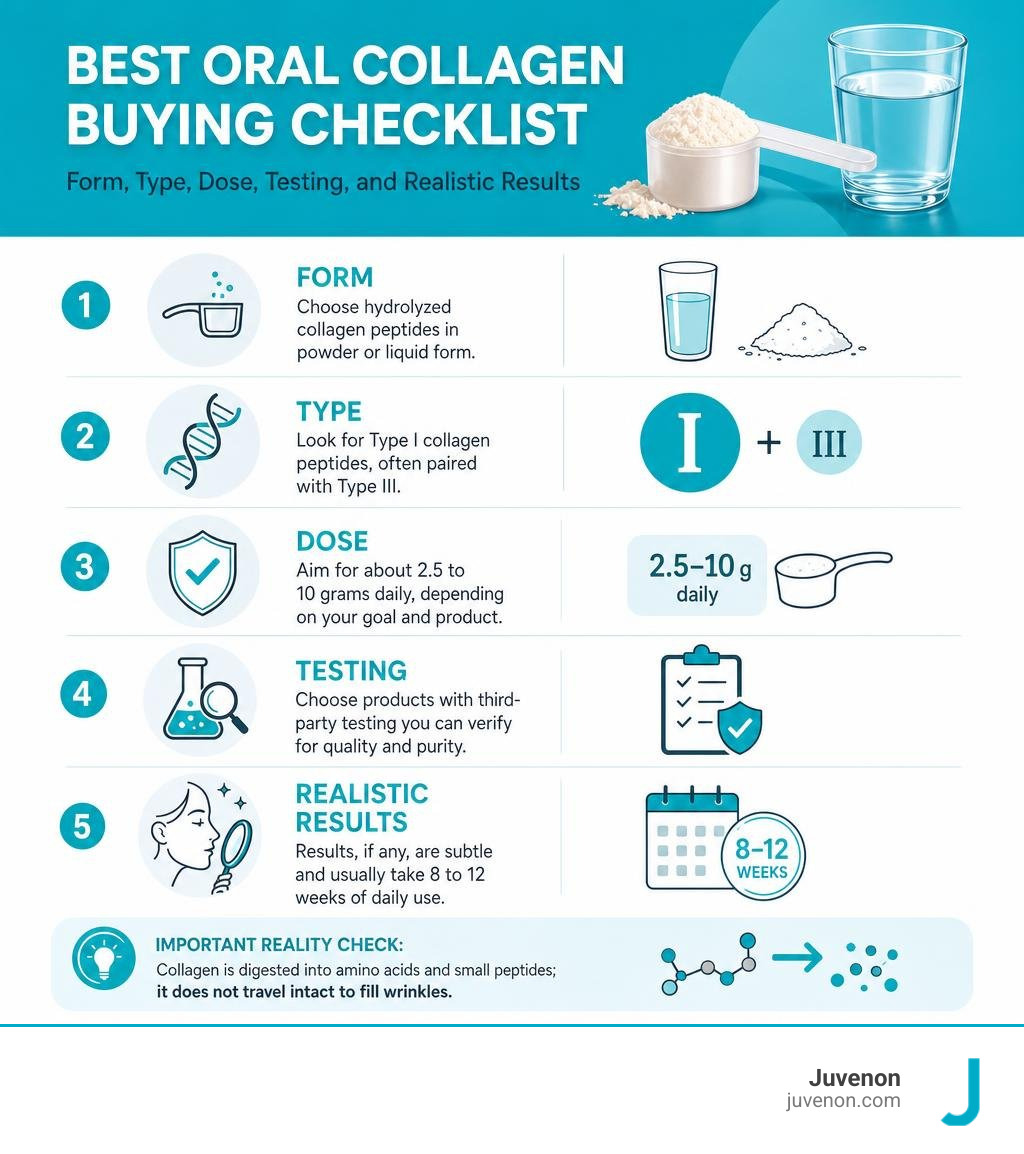
The best oral collagen is usually a hydrolyzed collagen peptide product with a clear daily dose, few unnecessary ingredients, and testing you can verify. For skin-focused goals, Type I collagen peptides are the most common choice; realistic results, if they occur, are subtle and usually take 8 to 12 weeks of daily use.
| Quick buying answer | What to look for |
|---|---|
| Best form | Hydrolyzed collagen peptides in powder or liquid form |
| Best type for skin | Type I, often paired with Type III |
| Evidence-based daily range | About 2.5 to 10 grams daily, depending on the goal and product |
| What to avoid | Vague proprietary blends, inflated promises, excess sugar, and unclear sourcing |
| Important reality check | Collagen is digested into amino acids and small peptides; it does not travel intact to fill wrinkles |
Collagen is the body's most abundant protein. It helps give skin its structure and supports tissues throughout the body, including bones, tendons, and joints. But natural production declines with age, while sun exposure, smoking, poor sleep, and other stressors can speed the visible effects.
That does not make every collagen product a smart buy. Research suggests hydrolyzed collagen may modestly support skin hydration and elasticity, but the science is mixed. A 2023 review of 26 randomized trials found improvements in hydration and elasticity, while later analyses found that skin benefits became far less convincing when industry-funded studies were removed. Think of oral collagen as a possible supporting habit, not a replacement for sunscreen, adequate protein, sleep, or proven skin care.
I am Michelle M. Henson, a copywriting leader and legal compliance editor with more than 20 years of experience translating health and supplement research into clear, responsible guidance. In this guide to the best oral collagen, I will help you separate useful buying criteria from marketing claims before you spend your money.
Collagen Types and Sources Explained
When you start browsing collagen supplements, the options can quickly get overwhelming. Label terms like "Type I & III," "grass-fed bovine," and "wild-caught marine" sound impressive, but understanding what they actually mean helps us make smart decisions.
In the human body, scientists have identified 28 distinct types of collagen, but three main types make up the vast majority of our physical structure:
- Type I: The most abundant form in the body. It forms dense fibers that provide tensile strength to skin, tendons, bones, and organs.
- Type II: The primary structural protein found in articular cartilage, giving joints their cushion and flexibility.
- Type III: Found alongside Type I in skin, blood vessels, and internal organs, contributing to elastic tissue matrixes.
Different dietary sources deliver different ratios of these types. To learn more about how collagen works across your body, explore our full guide on From Skin to Joints: Here's What Collagen Can Do for You.
| Collagen Source | Primary Collagen Types | Key Health Applications | Specific Benefits |
|---|---|---|---|
| Marine (Fish) | Type I | Skin hydration, fine lines, facial firmness | Smaller peptide sizes, highly bioavailable, rich in glycine and proline |
| Bovine (Cattle) | Type I & Type III | Skin elasticity, hair, nails, gut lining, bone matrix | Broad structural support, high hydroxyproline content, cost-effective |
| Porcine (Pig) | Type I & Type III | Dermal matrix density, tissue elasticity | High structural similarity to human collagen, low allergen risk |
| Avian (Chicken) | Type II | Articular cartilage, joint flexibility, stiffness relief | High in native glucosamine and chondroitin for joint cushioning |
Type I, II, and III Collagen Functions
If our goal is smoother skin and better hydration, Type I and Type III are the heavy lifters. Type I collagen maintains dermal density and structural integrity, preventing the skin from matrix breakdown as we age. Type III works synergistically with Type I, keeping tissues resilient and supple.
On the other hand, if our knees ache when climbing stairs or our shoulders feel stiff in the morning, Type II is where clinical attention shifts. Type II collagen specifically targets the cartilage that cushions our joints, helping maintain smoothness and flexibility during movement. For deeper joint guidance, check our article on 11 Vitamins for Joints You Need to Take Regularly and review strategies in Future-Proof Your Joints: Strategies for Lifelong Joint Health.
Marine, Bovine, Porcine, and Avian Sources
Where your collagen comes from matters for both efficacy and dietary preferences:
- Marine Collagen: Sourced from fish skin and scales (often wild-caught), marine collagen is rich in Type I. Its smaller peptide size makes it popular for cosmetic and anti-aging uses, though those with fish allergies must strictly avoid it.
- Bovine Collagen: Derived from cattle hides and bones, this source yields a blend of Types I and III. Look for grass-fed, pasture-raised options to ensure higher ethical standards and fewer unwanted contaminants.
- Porcine Collagen: Extracted from pig skin, porcine collagen closely resembles human amino acid structures, making it exceptionally bioavailable.
- Avian Collagen: Sourced from chicken sternum cartilage, this is the gold standard source for Type II joint formulas.
- "Vegan Collagen Boosters": Plants do not produce real collagen. Botanical supplements labeled as "vegan collagen" actually contain building blocks—such as vitamin C, proline, zinc, and silica—designed to support your body's natural synthesis.
To compare different supplement sources in detail, check out this guide on the Best Collagen Supplements: Which Type Should You Choose?.
How Bioactive Peptides Work and How to Choose the Best Oral Collagen Supplement Form
Raw collagen is a large, tough molecule—think of gelatine or bone broth. In its raw form, it is difficult for our digestive digestive system to break down and absorb efficiently. That is why modern oral collagen supplements undergo hydrolysis, an enzymatic process that cuts long protein chains into short bioactive chains called collagen peptides.
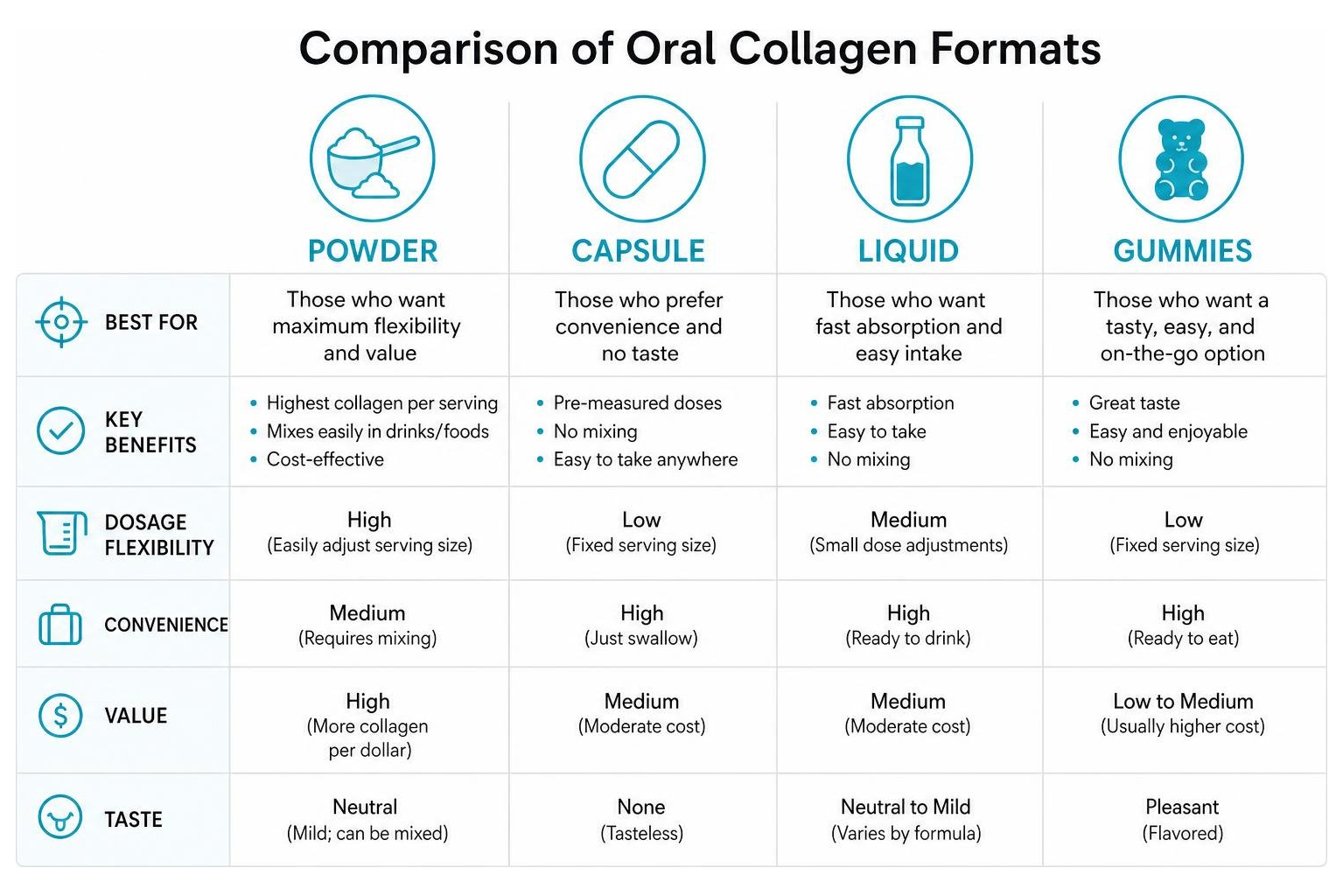
When evaluating the best oral collagen, the form you choose directly affects convenience, dosage accuracy, and value. For an overview of delivery methods, read Sip, Swallow, or Stir: The Real Benefits of Collagen Supplements.
Comparing Powders, Capsules, Gummies, and Liquids
- Powders (Hydrolyzed Collagen Peptides): Unflavored or lightly flavored powders offer the best versatility and value. They mix easily into morning coffee, smoothies, or water, delivering a full 5g to 10g serving without forcing you to swallow handfuls of pills.
- Capsules & Tablets: Convenient for travel, but physical space is a limiting factor. A standard capsule holds about 500mg to 1,000mg, meaning you might need to swallow 5 to 10 large capsules daily to achieve a clinically studied dose.
- Gummies: While tasty, gummies are usually the least efficient choice. They often contain high amounts of added sugars, artificial dyes, and very low doses of collagen (often under 1g to 2g per serving). Furthermore, gummy matrices are less chemically stable over time.
- Premade Drinks & Shots: Convenient and quick, liquid shots provide pre-dissolved peptides. However, they are significantly more expensive per gram, generate excess packaging waste, and often include added preservatives.
How the Body Absorbs the Best Oral Collagen Peptides
A common misconception is that ingested collagen travels straight to your face and fills in wrinkles like an internal cosmetic gel. That is simply not how biology works!
When we drink or swallow hydrolyzed collagen, our digestive proteases break the peptides down into individual amino acids (like glycine and proline) alongside small dipeptides and tripeptides. Uniquely, peptides containing hydroxyproline bonds resist complete breakdown in the stomach.
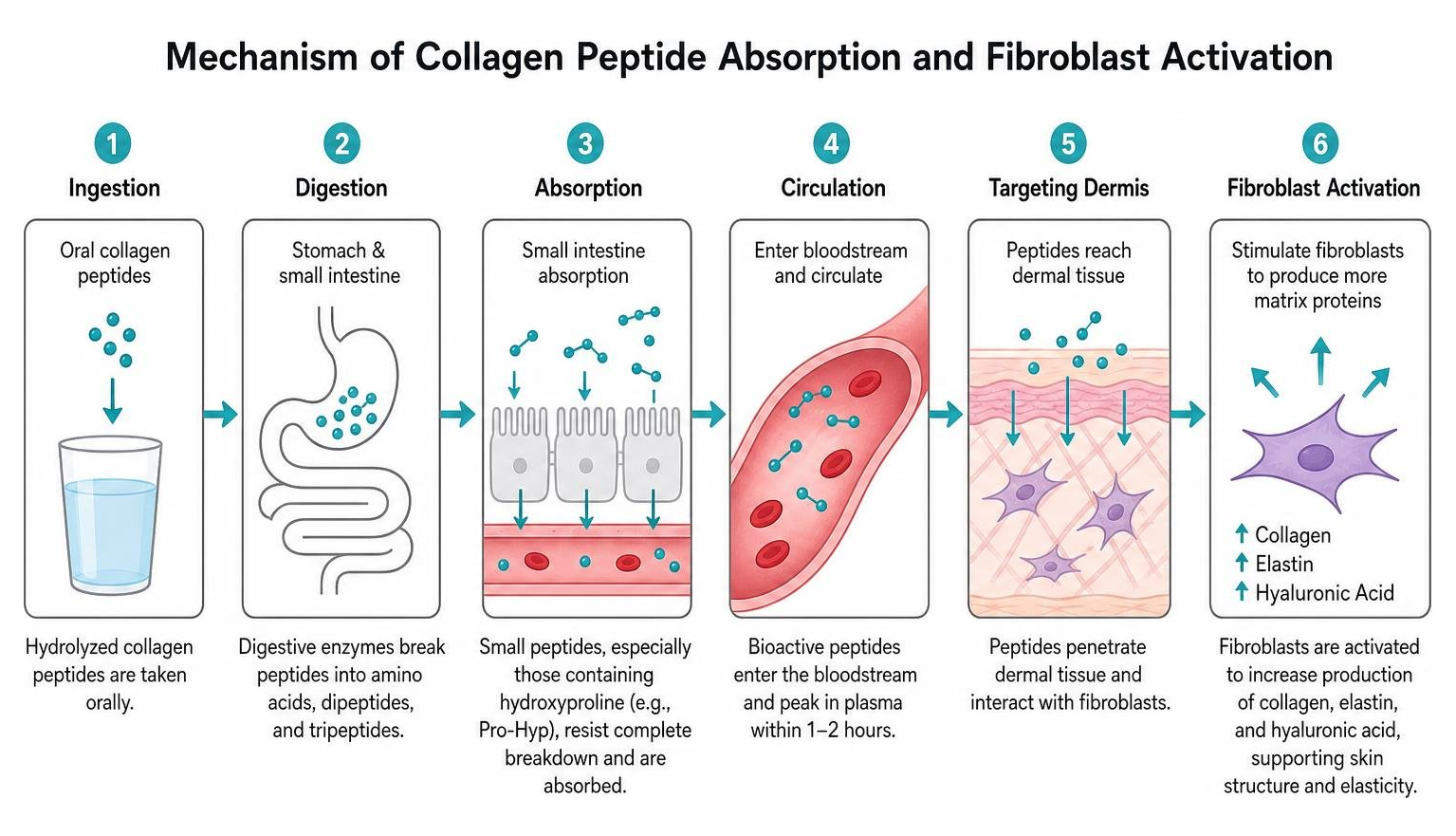
Clinical trials demonstrate that short bioactive fragments like proline-hydroxyproline (Pro-Hyp) survive digestion, enter the bloodstream, and peak in blood plasma within 1 to 2 hours. Once in circulation, these peptides act as biological messenger signals. When they reach dermal tissue, they stimulate dermal fibroblasts—the specialized cells responsible for producing new collagen, elastin, and hyaluronic acid.
To dive deeper into the bio-availability science, read Does Oral Collagen Reach Your Skin? The Honest Evidence.
Clinical Research on Collagen for Skin, Joints, and Bone Health
Does science support taking the best oral collagen? The answer is a qualified yes, provided our expectations stay grounded in facts rather than advertisement claims.
Skin Hydration, Elasticity, and Wrinkle Reduction
Numerous clinical trials have evaluated oral collagen peptides for skin aging:
- The Proksch Trial (2014): A landmark double-blind study evaluated 2.5g/day of specific collagen peptides in women aged 35–55. After 8 weeks, participants demonstrated statistically significant improvements in skin elasticity compared to the placebo group.
- 2023 Meta-Analysis: A comprehensive review analyzing 26 randomized controlled trials (1,721 total participants) concluded that hydrolyzed collagen significantly improved both skin hydration and elasticity.
- 2026 Meta-Analysis: A broader evaluation of 19 RCTs (1,341 participants) found that while wrinkle reduction reached statistical significance, the actual physical impact was modest (a mean wrinkle score reduction of 0.27).
However, independent research reviews urge caution regarding study bias. A 2025 systematic review of 23 RCTs revealed that when analysis was strictly limited to independent, non-industry-funded trials, the statistical benefits for hydration and wrinkles weakened significantly. Industry sponsorship does not render a study invalid, but it means we should view glowing marketing claims with a healthy dose of skepticism.
For practical daily habits to complement your routine, explore A Quick Guide to Restoring Your Skin Through Inside-Out Skin Care and learn How to Reduce Wrinkles That Come With Age.
Results Timeline for Skin, Joints, and Bones
Patience is vital when taking structural supplements. Collagen synthesis takes time, and results accumulate slowly across different tissues:
- Skin Hydration & Elasticity: 8 to 12 weeks of daily, uninterrupted supplementation.
- Joint Comfort & Stiffness Relief: 8 to 12 weeks of daily use, especially when paired with light movement.
- Bone Mineral Density & Structural Health: 12 months or longer of continuous daily supplementation.
If you are exploring natural solutions for joint discomfort, check our research review on Natural Cartilage Repair: The Next Big Thing in Joint Pain Relief and see if you Can You Restore Joints to a Pain-Free State?.
Dosage, Quality Red Flags, and Buying Criteria

Not all collagen powders are created equal. Because the FDA regulates supplements differently than prescription drugs, consumers must know how to inspect labels to find the best oral collagen.
Identifying Quality Brands and Red Flags
When shopping, keep an eye out for these crucial quality indicators and red flags:
- Third-Party Certification: Look for independent quality seals on the bottle, such as NSF International, USP, or Informed-Choice. These certify that the product actually contains what the label claims and has been tested for heavy metals like lead, mercury, and arsenic.
- GMP Compliance: Choose manufacturers operating under audited Good Manufacturing Practices (GMP).
- Transparent Sourcing: Quality products clearly state where their raw collagen originates (e.g., "Grass-Fed, Pasture-Raised Bovine" or "Wild-Caught Cold-Water Fish").
- Avoid Proprietary Blends: Steer clear of vague "beauty matrix" blends that conceal the exact dose of collagen behind a secretive brand formula.
- Minimize Sugar & Fillers: Skip products loaded with artificial sweeteners, synthetic food dyes, maltodextrin, or excess sugars.
For broader strategies on preserving youthful skin, check out our guide on 6 Ways to Reduce Premature Skin Aging and discover 11 Foods That Help You Look Younger.
Optimal Daily Dosing for the Best Oral Collagen
What is the ideal dose? Clinical trials show that 2.5 grams to 10 grams per day of hydrolyzed collagen peptides is the sweet spot for skin, hair, and joint support.
Taking more than 10g to 15g daily won't hurt you—collagen is very safe—but extra protein beyond your body's cellular signalling threshold is simply metabolized as standard calories. More is not always better!
- Essential Cofactor: Always ensure you have adequate Vitamin C intake (either in your diet or within the supplement formula). Vitamin C is an indispensable enzymatic cofactor required by your cells to cross-link amino acids into stable collagen fibers.
- Exercise Synergy: A study by Erskine and colleagues found that consuming collagen hydrolysate alongside vitamin C shortly before resistance exercise or joint loading significantly boosted target tissue collagen synthesis.
- Safety & Side Effects: Collagen peptides are well-tolerated. Minor side effects are rare but can include mild digestive fullness, bloating, or unpleasant lingering taste. Always check allergen warnings if you have fish, egg, or poultry sensitivities.
Frequently Asked Questions About Oral Collagen
How long does it take to see results from oral collagen supplements?
Visible or physical results require daily consistency over time:
- Skin Hydration & Smoothness: Most clinical trials measure noticeable improvements between 8 and 12 weeks.
- Joint Stiffness & Mobility: Noticeable reductions in activity-related knee or joint discomfort typically occur within 8 to 12 weeks.
- Bone Density: Bone turnover occurs very slowly; studies measuring bone density improvements track participants over 12 full months or longer.
Does oral collagen reach skin tissue as intact collagen?
No, oral collagen does not travel through your digestive tract as intact structural protein to directly "plug" wrinkles. Stomach enzymes and intestinal proteases break down collagen into short amino acid chains and bioactive dipeptides (such as Pro-Hyp). These small fragments enter your bloodstream and act as signal keys, stimulating your skin's fibroblast cells to synthesize fresh collagen and hyaluronic acid naturally.
What is the difference between marine and bovine collagen?
The primary differences lie in collagen type, origin, and particle size:
- Marine Collagen: Extracted from fish, it consists almost entirely of Type I collagen. Its smaller molecular weight allows for efficient digestive uptake, making it popular for targeting skin hydration and fine lines.
- Bovine Collagen: Sourced from cows, it provides a balanced mix of Type I and Type III collagen, supporting skin elasticity, bone matrix density, gut lining, and connective tissue.
Conclusion: Making an Informed Choice for Your Health
At Juvenon, we believe in empowering you with transparent, science-backed guidance for healthy aging and vitality. Finding the best oral collagen comes down to choosing a clean, hydrolyzed peptide powder or capsule that fits your daily routine, offers transparent sourcing, and delivers an evidence-based dose between 2.5g and 10g.
Oral supplements work best when integrated into a holistic lifestyle. Combining daily collagen peptides with proper hydration, nutrient-dense whole foods, daily sunscreen, and proper sleep yields the best long-term results for your skin and joints.
Ready to explore how collagen fits into your overall anti-aging routine? Learn more about supporting your body from within by reading our feature guide on From Skin to Joints: Here's What Collagen Can Do for You.